


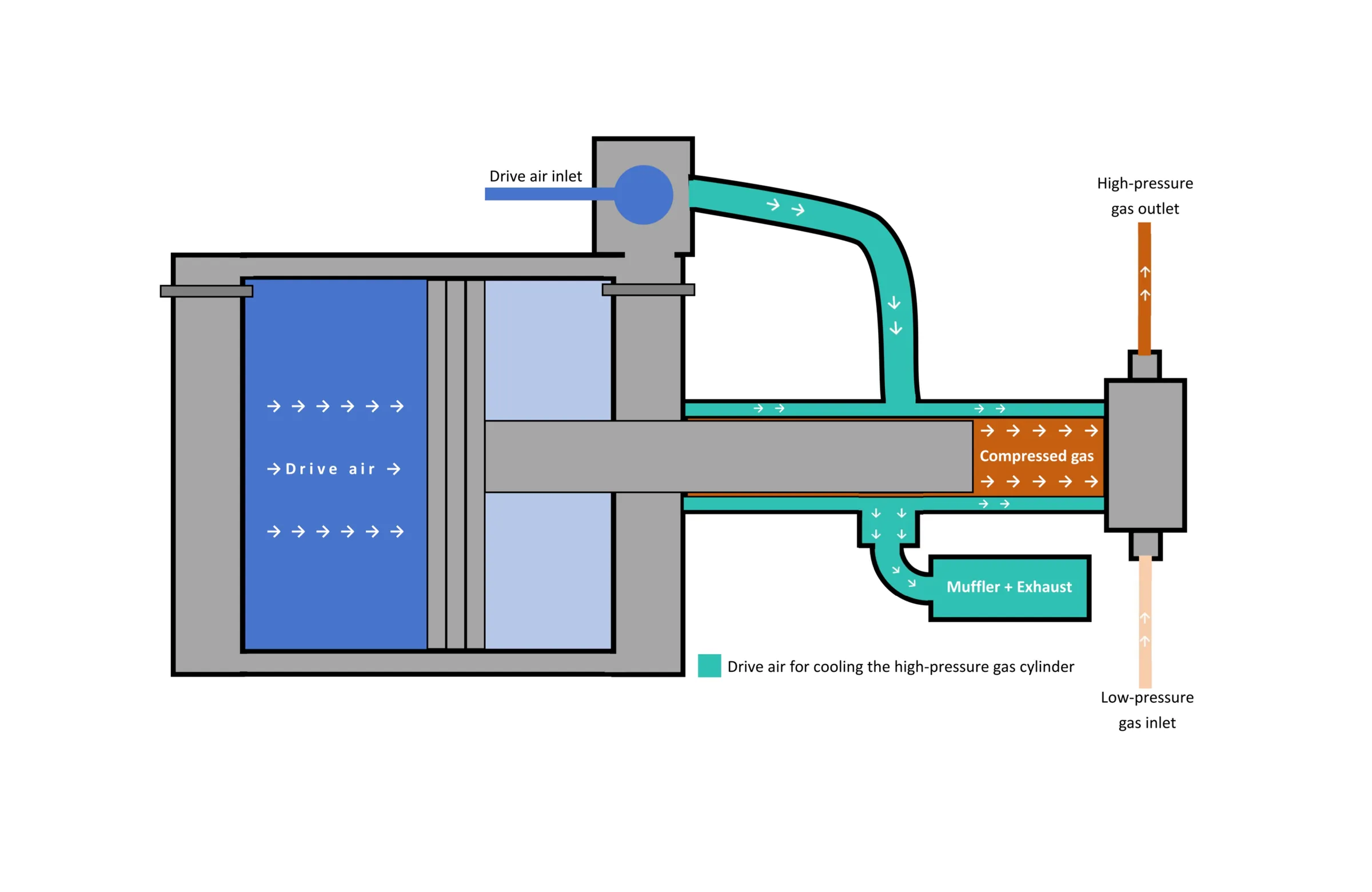
A pneumatic single-acting booster pump (also known as an air-driven gas or liquid booster) operates on a fundamental mechanical concept: pressure intensification through differential piston areas.
It uses standard plant air (typically 3 to 10 bar / 45 to 145 psi) to generate significantly higher gas or liquid pressures (up to thousands of bar).
The Core Principle: Differential Surface Area
The booster connects a large-diameter air drive piston directly to a small-diameter high-pressure plunger via a shared shaft.
Because both pistons are linked, the mechanical force generated on the large drive side equals the force exerted by the small plunger side:
Rearranging this gives the pressure amplification formula:
Because the air piston’s surface area (Adrive) is much larger than the plunger’s area (Aplunger), low air pressure is amplified proportionally into high output pressure.
Why "Single Acting"?
In a single-acting booster pump, high-pressure fluid/gas is displaced and pressurized during only one direction of the stroke (the drive stroke). The return stroke is dedicated purely to pulling new fluid into the compression chamber.
Step-by-Step Working Cycle:
1. Suction (Return) Stroke:
Filling the high-pressure chamber
Drive air pushes the large piston backward (or a return spring assists). As the small plunger retracts inside the high-pressure cylinder, it creates a vacuum. This closes the outlet check valve and opens the inlet check valve, drawing fresh fluid or gas into the compression chamber.
2.Compression (Drive) Stroke:
Discharging pressurized fluid
A directional spool valve switches air flow to the opposite side of the large piston, forcing it forward. The connected small plunger compresses the fluid inside the small chamber. The inlet check valve snaps shut under pressure, forcing the outlet check valve open to discharge high-pressure fluid into the system.
3.Spool Valve Reversal:
Automatic reciprocation
At the end of the stroke, internal pilot valves are mechanically triggered. They shift the directional air spool valve, instantly reversing the drive air flow to restart the cycle automatically.
4.Auto-Stall Balance:
Reaching target pressure
As outlet pressure builds, the resistance on the small plunger increases. When the high-pressure force matches the force on the drive air piston (Pdrive · Adrive = Pout · Aplunger) the pump stalls and stops cycling. It consumes zero energy while maintaining pressure.
Key Advantage: Unlike electric pumps, pneumatic boosters generate no heat while holding pressure and restart automatically whenever downstream pressure drops.