


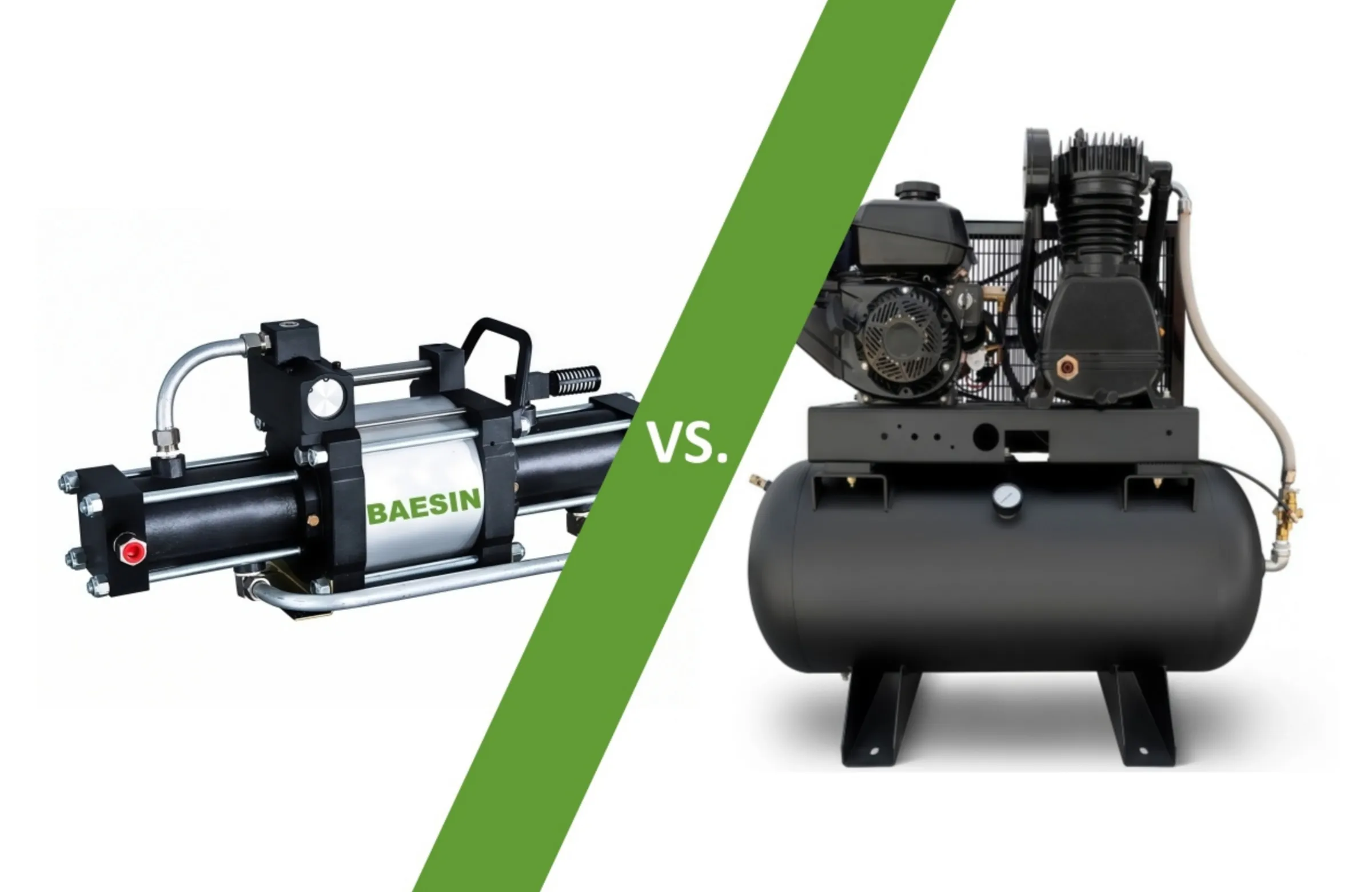
Pneumatic booster pumps and electric gas compressors are two distinct technologies used to compress gases and boost system pressures. The fundamental difference lies in their power source and operation mechanism: pneumatic boosters use compressed shop air to drive a differential area piston, whereas electric compressors use an electric motor to turn a crankshaft, screw, or scroll.
Direct Comparison:
| Feature | Pneumatic Booster Pump | Electric Gas Compressor |
|---|---|---|
| Power Source | Compressed air (3–8 bar) | Electrical power grid / generator |
| Flow Rate Capability | Low to moderate flow | High to continuous heavy-duty flow |
| Pressure Range | Extremely high pressures (up to 1,600+ bar) | Medium to high pressures |
| Heat Generation | Minimal (expanding drive air cools the pump) | High (requires cooling systems / radiators) |
| Stall Ability | Can stall under pressure with zero power draw | Cannot stall; requires bypass or motor stop |
| Explosion Safety | Inherently explosion-proof (no electrical spark) | Requires expensive explosion-proof enclosures |
| Duty Cycle | Intermittent On-demand pressure holding | Continuous duty |
| Maintenance & Portability | Highly compact Lightweight few moving parts | Heavy complex mechanical drive components |
Key Advantages of Pneumatic Booster Pumps
1. Inherently Explosion-Proof (ATEX / Hazardous Locations):
Because they operate entirely on compressed air with no electrical wiring, switches, or motors, pneumatic boosters generate no electrical sparks. This makes them ideal for hazardous zones involving flammable gases (e.g., hydrogen, methane, oxygen).
2. Infinitely Adjustable & Auto-Stalling:
Simple Control: Output pressure is controlled by adjusting a simple air pressure regulator on the drive inlet.
Zero Energy Idle: When the downstream system reaches the target pressure, the booster automatically stalls due to force balance (Pdrive · Adrive = Pout · Aplunger). It consumes zero energy and generates no heat while maintaining maximum pressure static hold.
3. Cool Operation (Self-Cooling):
As the compressed drive air exhausts from the pump during operation, it expands rapidly. This adiabatic expansion lowers the temperature of the exhaust air, naturally cooling the pump body and counteracting compression heat.
4. Compact Power-to-Weight Ratio:
Pneumatic boosters are significantly lighter and smaller than electric compressors capable of reaching similar pressures, making them easy to mount on mobile carts or field testing rigs.
Suitable Application Scenarios
Choose a Pneumatic Booster Pump when:
- Intermittent High-Pressure Holding: Filling accumulator bottles, burst/hydrostatic testing of pipes, pressure relief valve testing.
- Hazardous / Inflammable Environments: Offshore oil rigs, chemical processing plants, hydrogen refueling stations, and oxygen clean-room transfer.
- Low Supply Pressure Enhancement: Boosting existing facility bottle pressure (e.g., topping off 200 bar nitrogen bottles from a 50 bar source).
- Mobile & Field Work: Portable test benches powered by field service air trucks.
Choose an Electric Gas Compressor when:
- Continuous High Flow Rates: Supplying constant gas volume to industrial manufacturing lines, large-scale air separation plants, or continuous pipeline transport.
- Base Load Operations: Scenarios where high electrical drive efficiency outweighs the lower capital cost of pneumatic drives over long continuous runtimes.
- No Existing Compressed Air Infrastructure: Facilities that do not already have an established shop-air network.