


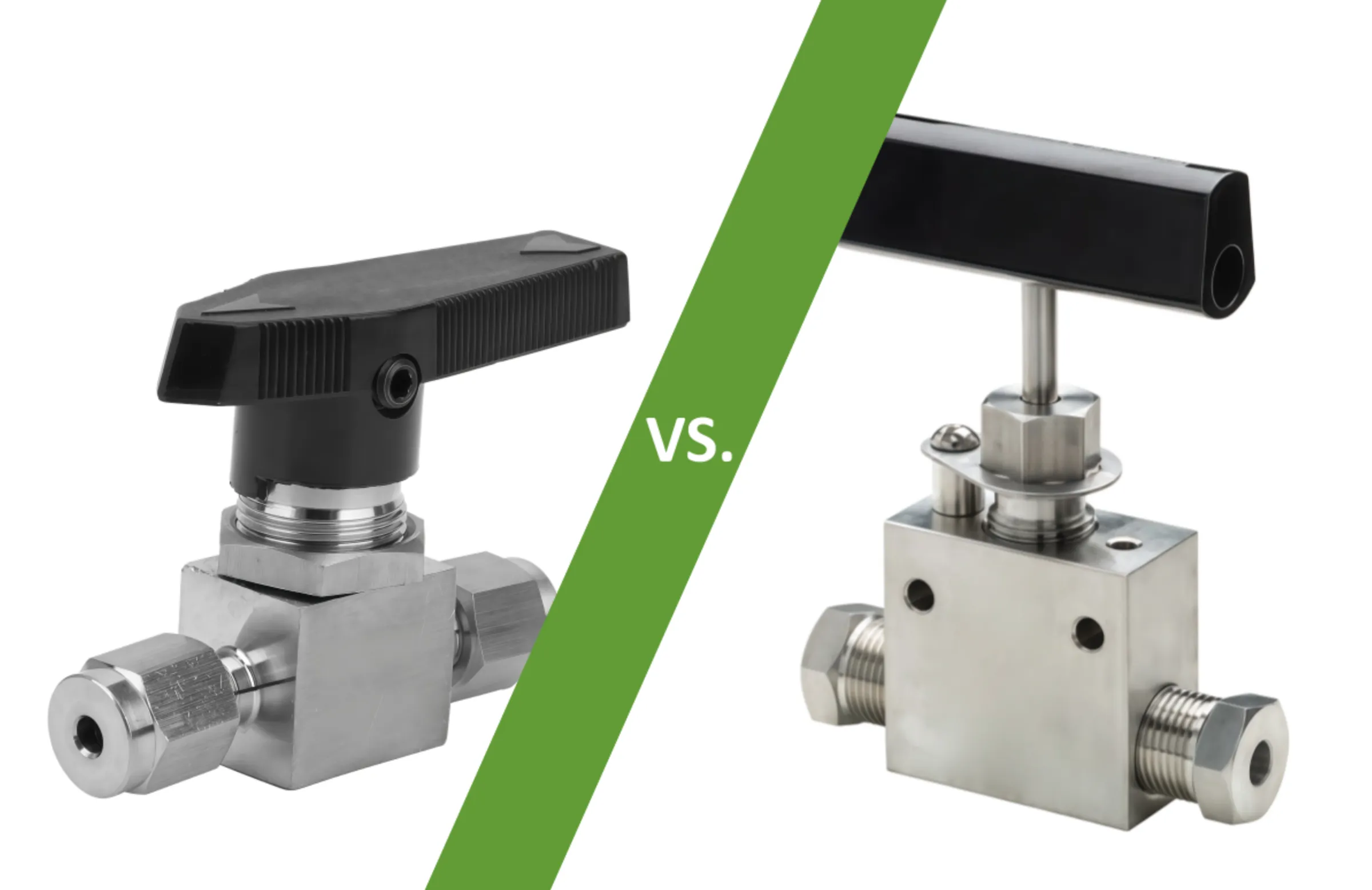
In high-pressure pneumatic equipment, the core difference between ball valves and needle valves comes down to design intent: ball valves are built for fast on/off switching, while needle valves are built for precise flow control.
Structural Differences:
| Aspect | Ball Valve | Needle Valve |
|---|---|---|
| Closure Element | A sphere (ball) with a through-bore. A 90° rotation fully opens or closes the valve. | A tapered or needle-shaped plunger that moves linearly in and out of the seat by turning the handwheel. |
| Operation | Quick and intuitive - handle position (parallel/perpendicular to the pipeline) indicates open/closed status. | Slow and precise - requires multiple turns of the handwheel; open position is not visually obvious. |
| Flow Path | Straight and wide – nearly the same diameter as the pipe, offering very low flow resistance. | Narrow and tortuous - fluid passes through a small tapered gap, causing significant pressure drop. |
Performance Comparison:
| Characteristic | Ball Valve | Needle Valve |
|---|---|---|
| Primary Function | Quick shut-off / on-off control | Precise flow regulation |
| Throttling Capability | Not suitable for throttling designed for full open or full closed | Excellent – allows fine, incremental flow adjustment |
| Pressure Rating | Wide range – standard types up to 400 bar; high-performance designs (e.g., trunnion-mounted) can handle higher pressures | Typically higher – standard instrument needle valves rated to 6000 PSI (~414 bar); special designs can exceed 1600 bar |
| Flow Capacity | High – full-bore design offers minimal restriction | Low – flow path is intentionally restricted |
| Typical Applications | Main pipelines, emergency shut-off systems, where rapid operation is needed | Instrumentation, sampling systems, calibration rigs, where precision matters |
Selection Guidelines:
- Define your priority: Do you need a switch or a regulator? Ball valves excel at speed and high flow; needle valves excel at precision and fine control.
- Match pressure ratings: Always verify that the valve's rated pressure exceeds your system's maximum working pressure. Needle valves generally offer higher pressure ratings, but high-performance ball valves can also handle 400 bar+ applications.
- Avoid misuse: Neveruse a ball valve for throttling – this will damage the sealing surfaces. Neverexpect a needle valve to act as a quick shut-off – its multi-turn design cannot provide instant closure.
Summary:
Ball valves are your go-to for fast, high-flow on/off control; Needle valves are the right choice when you need precise, adjustable flow – especially at very high pressures.