


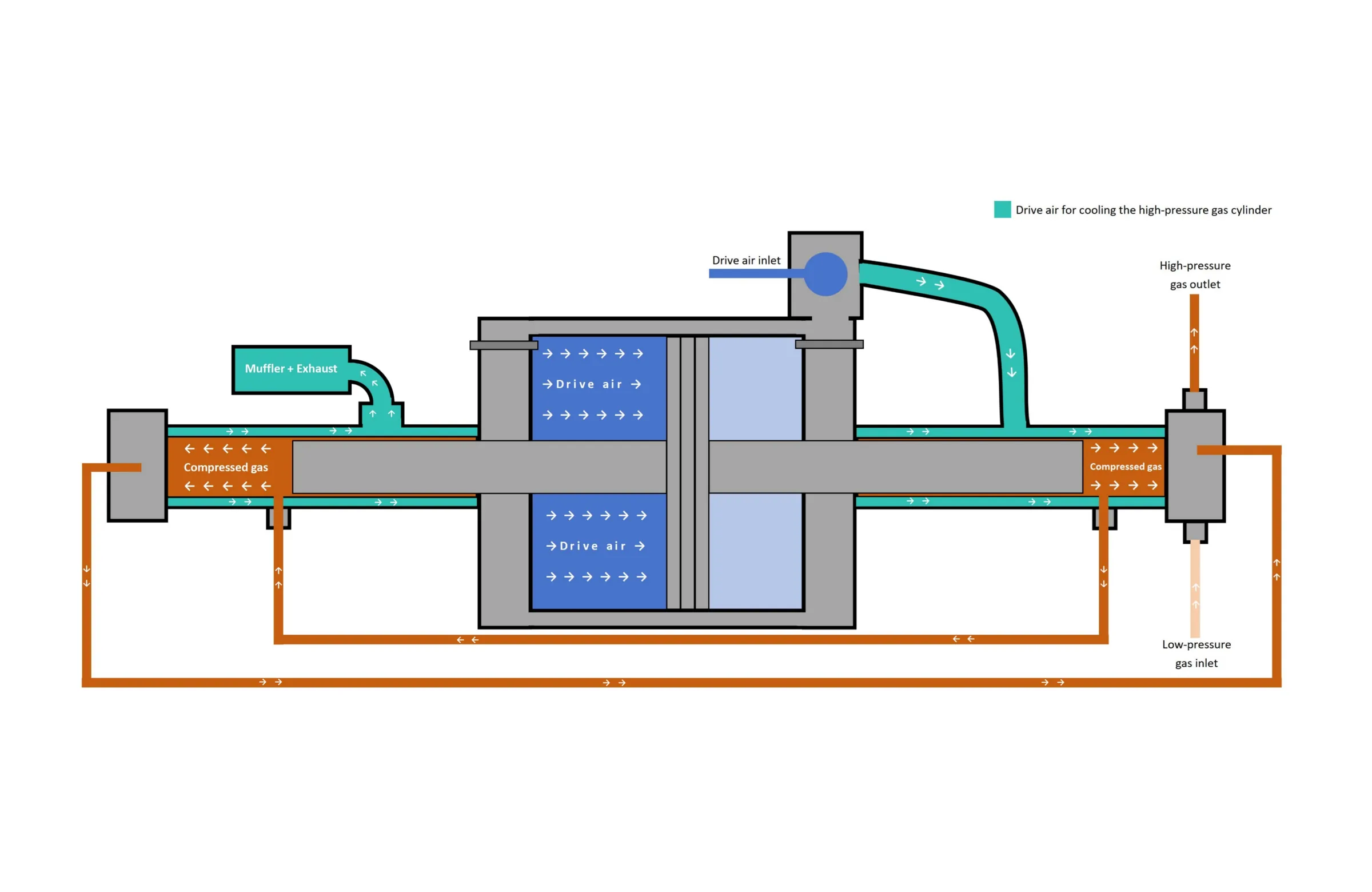
A pneumatic double-acting booster pump operates on the exact same core concept of area differential force multiplication as a single-acting model, but with a major structural upgrade: two high-pressure fluid heads attached to opposite ends of a central air drive piston.
This allows the pump to discharge high-pressure gas or liquid on both stroke directions (forward and reverse), doubling flow output and eliminating dead return time.
Pressure Intensification Formula
Just like in a single-acting booster, force equality across the shared connecting shaft determines the amplification ratio:
Because a central drive piston drives plungers on both sides, every single movement of the piston delivers high-pressure fluid downstream.
Step-by-Step Working Cycle
1. Forward Stroke (Left to Right):
Simultaneous suction and discharge
Drive air enters the left side of the large drive cylinder, pushing the piston assembly right.
Right Chamber: The right plunger compresses fluid in its chamber, opening its outlet check valve to deliver high-pressure output.
Left Chamber: Simultaneously, the retreating left plunger creates suction, opening its inlet check valve to draw fresh fluid in.
2. End-of-Stroke Reversal:
Pilot valve triggering
As the piston reaches the end of its stroke, it contacts a mechanical pilot valve (firing pin). This shifts the main directional shuttle valve, instantly diverting drive air to the right side of the large piston.
3.Return Stroke (Right to Left):
Reversing high-pressure roles
Drive air pushes the assembly back to the left.
Left Chamber: The left plunger now compresses the fresh fluid it drew in during Step 1 and discharges it under high pressure.
Right Chamber: The right plunger retracts, creating suction and filling its chamber with fresh fluid.
4.Continuous Flow or Auto-Stall:
Continuous operation or stall
The pump cycles back and forth continuously, producing smooth, near-constant output flow. When downstream system pressure reaches the maximum intensified pressure limit, force equilibrium stalls the pump instantly without consuming energy.
Single-Acting vs. Double-Acting Comparison:
| Feature | Single-Acting | Double-Acting |
|---|---|---|
| Pulsion Pattern | Intermittent(Discharges on 1 stroke only) | Continuous (Discharges on both strokes ) |
| Flow Rate | Standard | Roughly 2× higher |
| Pressure Pulsation | High pulsation | Lower, smoother pulsation |
| Physical Size | Compact | Wider (due to dual end-caps) |
| Ideal For | High-pressure testing, holding pressure | High-volume transfer, fast filling |